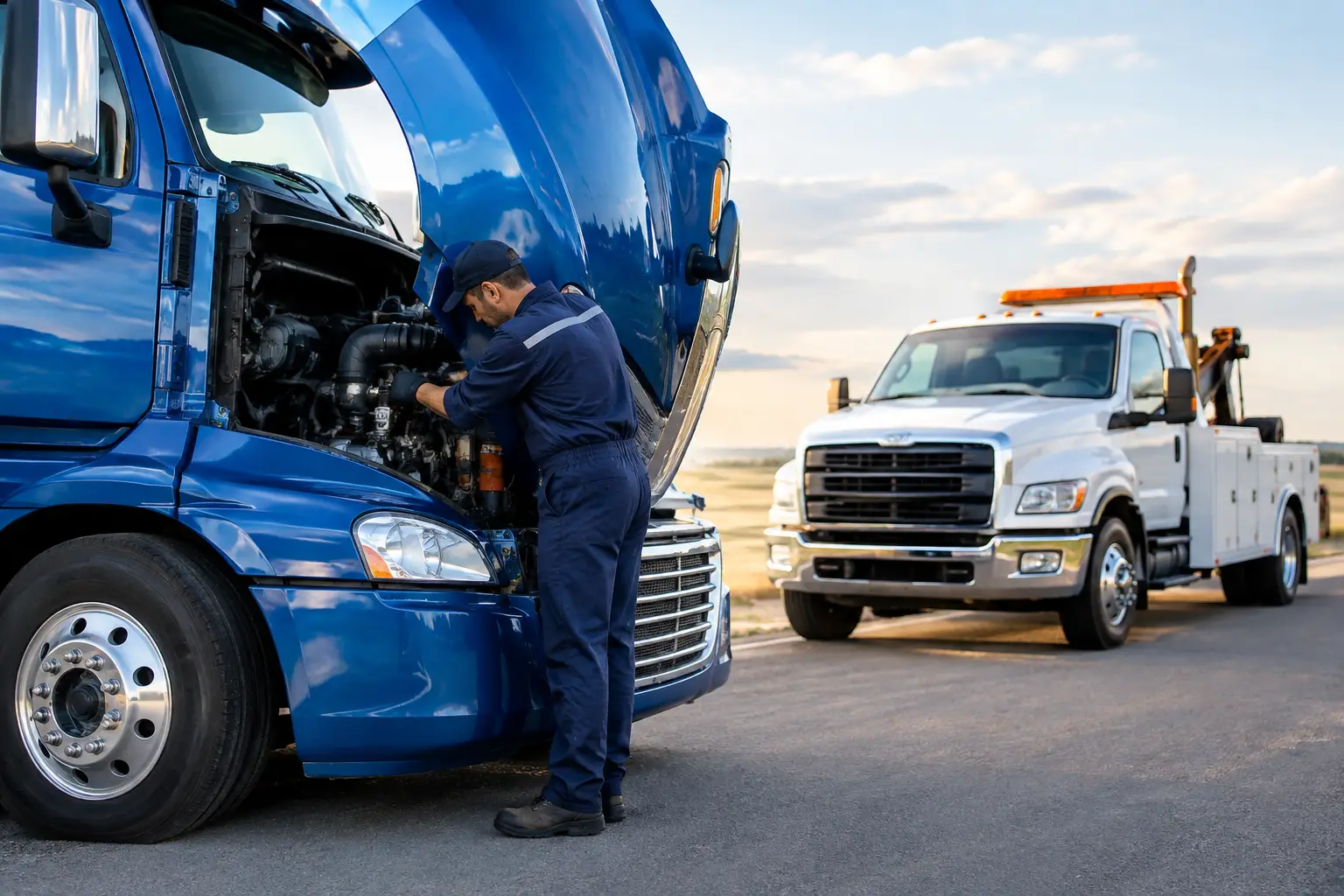
A loaded tractor-trailer loses air pressure on I-85, a no-start fault appears at a shipper, or a trailer light failure puts a driver out of compliance after dark. In those moments, the question is not just what does roadside assistance cover. The real question is whether a qualified mobile technician can make the repair where the truck sits and get the equipment moving without an expensive tow or a missed delivery.
For commercial trucks, roadside assistance is emergency support delivered at the breakdown location. Depending on the provider, the truck’s condition, available parts, and the safety of the location, it can include diagnostics, mechanical repair, tire service, electrical work, trailer repair, and coordination for towing when the unit cannot be safely repaired on site.
What Does Roadside Assistance Cover for a Semi-Truck?
Heavy-duty roadside assistance typically covers the labor and response needed to identify and address a mechanical problem that has stopped, restricted, or made the vehicle unsafe to operate. It is not limited to a jump-start or a fuel delivery. A properly equipped mobile repair service can handle many failures that would otherwise require a shop visit.
The exact scope depends on the dispatch agreement, the truck’s warranty or roadside plan, the parts required, and the severity of the failure. Roadside assistance may cover the service call and diagnosis but not replacement parts, fluids, tires, towing, or after-hours charges. For fleets, authorization requirements can also determine what work a technician is allowed to perform before repairs begin.
The objective is straightforward: diagnose the issue, make a safe field repair when practical, and return the truck or trailer to service with the least possible downtime.
Common Mobile Repairs Covered at the Roadside
Diesel engine diagnostics and no-start repairs
A truck that cranks but will not start may have a fuel delivery issue, low voltage, a failed sensor, a wiring fault, a starter problem, or an emissions-related derate. Mobile diesel diagnostics can read fault codes, check battery voltage and charging performance, inspect connections, verify fuel system conditions, and narrow down the cause before parts are replaced.
Some no-start repairs can be completed roadside. A loose battery connection, damaged cable, failed relay, minor fuel system issue, or accessible sensor fault may be resolved with the right parts and diagnostic equipment. Internal engine damage, major fuel contamination, or a problem requiring extensive teardown generally cannot.
Electrical system service
Electrical faults create more than a starting problem. They can affect headlights, marker lights, turn signals, ABS warnings, trailer connections, charging systems, liftgates, and other equipment needed for safe operation.
Roadside electrical repair often includes testing batteries and alternators, repairing damaged wiring, replacing fuses and relays, addressing corroded connections, and tracing faults at the tractor-trailer electrical connector. A technician can also determine whether the issue is on the truck side, trailer side, or within an individual circuit. That matters when a driver needs to know whether the trailer can be legally and safely moved.
Air brake and brake system repairs
Low air pressure, an audible air leak, dragging brakes, brake chamber issues, damaged air lines, or warning lights require immediate attention. Air brake problems can put a truck out of service and should never be treated as a minor inconvenience.
Mobile roadside service may include locating and repairing accessible air leaks, replacing damaged air lines or fittings, servicing certain brake components, and checking related connections. The technician must confirm that the repair restores safe braking operation. If brake damage is severe, if components are overheated, or if the repair cannot be verified safely at the roadside, towing or a controlled move to a repair facility may be necessary.
Tire service and wheel-end problems
A blown drive tire, trailer tire failure, flat tire, or slow leak can stop a load immediately. Roadside tire service may include replacing a damaged tire, repairing a serviceable puncture when appropriate, checking inflation, and inspecting the wheel area for damage.
Not every tire problem is just a tire problem. Repeated tire damage, uneven wear, melted components, damaged studs, or signs of a wheel-end failure can point to a larger mechanical issue. If a hub, bearing, brake component, or wheel hardware is compromised, putting on a replacement tire alone may not make the truck safe to continue.
Trailer repair
Commercial roadside assistance commonly extends to the trailer because the trailer is often what prevents the load from moving. Technicians may repair lighting circuits, damaged electrical connectors, air lines, brake-related connections, landing gear issues, door hardware, and other accessible trailer defects.
Refrigerated trailers, specialized equipment, and major structural damage can require more specific service. A trailer with cargo-securement concerns, damaged suspension, a broken axle component, or a major box or frame issue may need a shop, recovery service, or load transfer rather than a roadside repair.
DPF and emissions-system diagnostics
DPF, DEF, SCR, and other aftertreatment faults can trigger warning lights, reduced power, derates, or no-start conditions. These problems require proper diagnostics. Clearing codes without correcting the underlying fault can leave the driver stranded again or create a more serious emissions-system issue.
Roadside DPF diagnostics can identify active and stored fault codes, assess sensors and related electrical circuits, check for common DEF and aftertreatment issues, and determine whether a parked regeneration or a repair is appropriate. Some failures can be corrected in the field. Others require shop-level cleaning, component replacement, or repairs that cannot be performed safely on the shoulder.
What Roadside Assistance May Not Cover
Mobile repair is designed to solve urgent failures, but it has practical limits. Major engine failure, transmission or clutch replacement, severe collision damage, extensive wiring harness replacement, internal differential damage, and significant frame or suspension repair usually require a shop environment.
Location also affects what can be done. A truck parked in an unsafe lane, on a narrow shoulder, under a low bridge, or in a restricted facility may need to be moved before a technician can work safely. Weather, traffic, cargo type, and local enforcement conditions can also change the repair plan.
Parts availability is another factor. A technician may diagnose the failure quickly but need to source a specific sensor, brake component, tire size, or trailer part. Fast diagnosis still saves time because it prevents unnecessary repairs and helps dispatch arrange the correct next step.
Roadside Assistance Coverage Versus Repair Cost
Many drivers use the word “coverage” to mean two different things. One meaning is the type of service a mobile provider can perform. The other is who pays for it.
A manufacturer warranty, insurance policy, fleet maintenance agreement, lease program, or roadside membership may cover some dispatch, towing, or labor costs. It may also have limits on distance, hourly rates, after-hours work, approved vendors, or parts. Wear items such as tires, brakes, batteries, and certain emissions components are often handled differently than a warrantable defect.
Before authorizing work, fleets should confirm the unit number, customer or warranty authorization, billing contact, purchase-order requirement, and any repair limit. Owner-operators should ask for a clear description of the issue, the recommended repair, and whether parts or towing are likely to add to the bill. Clear approval prevents delays once the technician has found the problem.
What to Tell Dispatch When Your Truck Is Down
The fastest roadside response starts with accurate information. Provide the exact location, direction of travel, truck and trailer numbers, equipment make and model, and a callback number. If the vehicle is loaded, mention the cargo type and any time-sensitive delivery requirement.
Explain what happened before the failure. Note dash warnings, fault codes, air-pressure readings, whether the engine cranks, visible leaks, smoke, tire damage, brake symptoms, or lighting defects. Photos can help when it is safe to take them, especially for tire, trailer, and visible air-line damage.
Also state whether the truck is in a safe parking area or exposed to traffic. That allows the service provider to plan the right response vehicle, diagnostic tools, repair parts, and safety precautions. A vague report can send the wrong equipment. A detailed report helps get the right technician to the truck the first time.
When Towing Is the Better Call
Towing is not a failure of roadside assistance. It is sometimes the safest and least costly decision. Continuing with compromised brakes, steering, wheel-end components, structural damage, or a severe engine problem can create a crash risk, cargo loss, and much larger repair bill.
A professional mobile technician should be willing to say when a field repair is not appropriate. The right decision is based on safe operation, not on forcing the truck to move for a few more miles. If towing is needed, accurate diagnosis before the tow can still prevent the truck from being taken to the wrong facility.
For drivers and fleets operating around Spartanburg and regional freight corridors, 24/7 mobile support from Eugen Solution Semi Truck & Trailer Repair is built around that decision point: repair the equipment on location when it is safe and practical, or help establish the next step when it is not.
When a breakdown happens, protect the scene, collect the fault information, and report the problem clearly. The right roadside response does more than address a disabled truck – it gives the driver, dispatcher, and customer a workable path back to the road.
Leave a Reply